Kitchen & Bath
What Defines A Contemporary Bathroom?
A contemporary bathroom reflects current materials, tech, and detailing rather than period mouldings or traditional fixtures. The architecture is linear and streamlined – flat-front cabinetry, rectilinear forms, calm surfaces – and the clutter is hidden, so what you see is architecture, not products.
Four Principles Guide Every Contemporary Scheme:
Linear, streamlined forms. Unbroken horizontal lines, flat-front cabinetry, large-format tile, and minimal grout for a sense of openness.
Sleek, wall-hung fixtures. Floating vanities, wall-mounted WCs, and slimline taps that make the room feel lighter and larger.
Hidden storage. Clean benchtops because everything is planned behind doors, in drawers, and into niches.
Integrated, quiet tech. Smart mirrors, digital shower controls, or touchless taps that feel high-end rather than showy.
In a period property, contemporary often means a crisp insert that contrasts deliberately with original doors, sash windows, or cornices – character in the envelope, ultra-clean detailing in the fit-out.
Layout
In a typical London or Home Counties footprint – often a period shell – a contemporary layout earns its keep by keeping lines unbroken and sightlines clear, so a small room reads as open and continuous.
A Few Choices Do The Heavy Lifting:
Wall-hung vanities and WCs. The floor reads as one continuous surface, lightening the room and making cleaning easier.
Flush or level-access shower trays with frameless glass. No visual break, maximum light through a narrow space.
Planned, hidden storage. Niches, drawers, and tall towers so benchtops stay clear and the architecture leads.
The aim throughout is continuity – large-format surfaces, minimal grout lines, and a crisp contrast against any original period features.
Colour Palette
Contemporary bathroom palettes lean on a neutral base (whites, charcoals, soft greys, taupes, and black) for a calm, gallery-like backdrop, lifted with controlled contrast or one or two curated accents.
Neutral base. Whites, soft greys, taupes, and charcoal for a composed, gallery-like feel.
High contrast. Black or dark accents against white or light stone – black-framed screens, dark vanity fronts, a charcoal floor under white walls.
Warm or cool neutrals. Crisp white with light grey and chrome for a sharp, spa-like feel in north-facing rooms; or mushroom, greige and stone-beige with off-white for a softer, hotel-like mood.
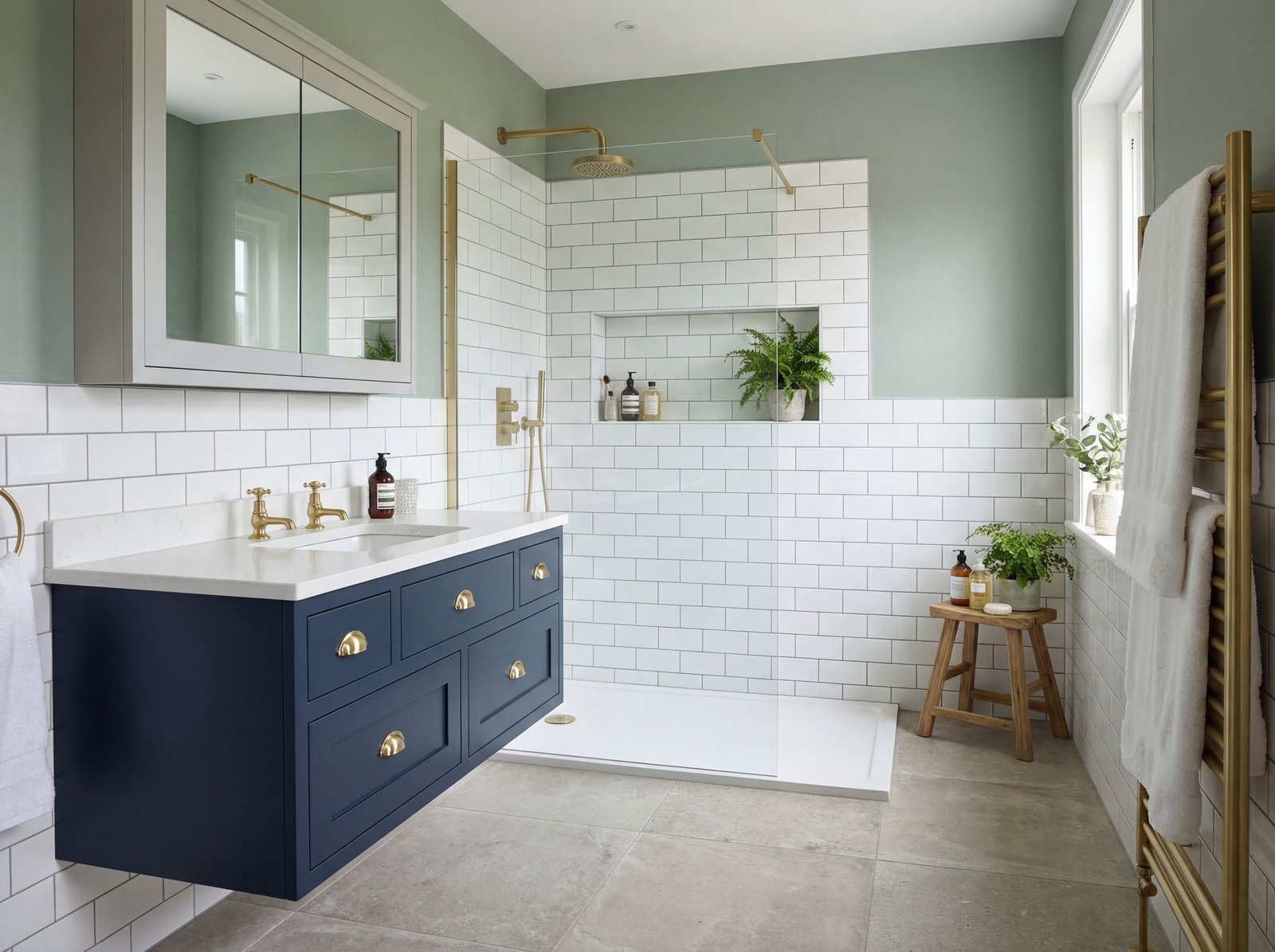
Controlled accent. A navy vanity, a single tiled feature wall, or accessories in deep green, rust, or teal – concentrated in one or two areas rather than scattered.
In A Small Or Windowless Room…
Go light and tonal with just small black details. In a brighter room you can push deeper charcoals or a coloured tile. Warm woods and stone-look tiles still read contemporary if the lines stay ultra-clean.
Materials
Materials carry the look in a contemporary bathroom, chosen for a near-seamless finish and real practicality (large formats, minimal joints, robust surfaces) which matters here where hard water and humidity are constant.
Large-format tile. Porcelain or ceramic on floors and key walls for a near-seamless look that's practical in wet areas.
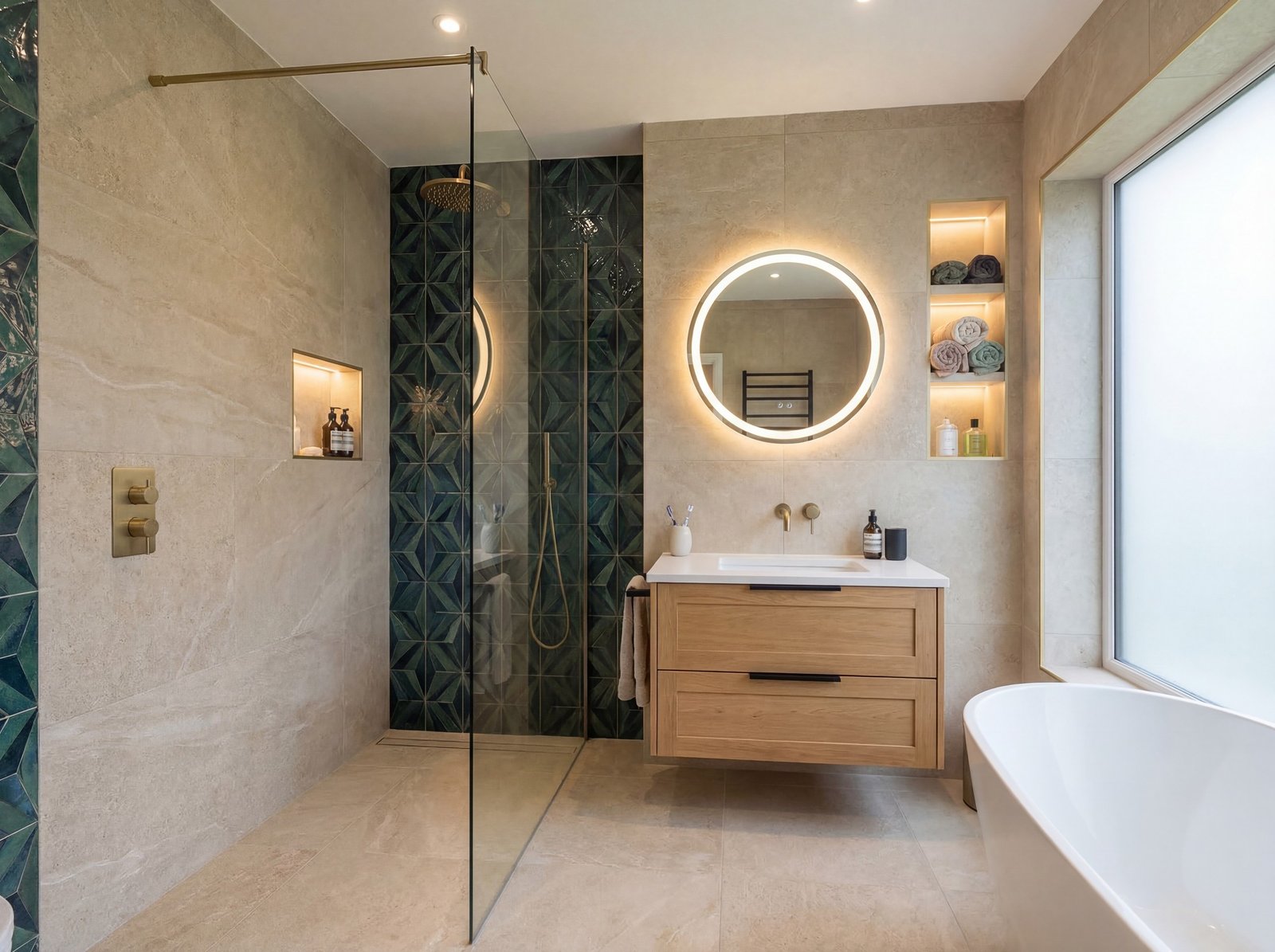
Stone and stone-look. Quartz, porcelain slabs, or large-format stone-look tile for vanity tops and feature walls – the luxury of stone with less maintenance. Real marble or limestone used selectively where patina is welcome.
Glass. Frameless or minimal-frame enclosures to keep lines clean and the space open, especially in narrow Victorian or Edwardian footprints.
Metals. Chrome, brushed nickel, stainless, and increasingly brushed brass or bronze – always in a clean, unfussy profile.
Wood. Flat-panel oak, walnut, or ash veneers to warm the room against stone or solid-surface counters.
Solid surface. Corian-type basins and tops for integrated sinks, soft internal radii, and very clean outer lines.
For Our Conditions…
We specify underfloor heating under porcelain, slip-resistant tile where it's needed, and moisture-resistant substrates behind any large-format tiling – and favour quartz or solid-surface tops, which hold up well in a hard-water area.
Lighting
Layered lighting is essential – ambient, task, and accent working together – so a contemporary bathroom never feels flat or clinical.
Ambient. Slimline recessed downlights or low-glare surface fittings for general light, positions planned exactly to avoid a "swiss cheese" ceiling.
Task. Vertical lights flanking the mirror, or an integrated LED mirror, for even, shadow-free grooming light – far better than a single overhead downlight.
Accent. LED strips under floating vanities, in shower niches or around mirrors for a subtle glow that emphasises the architecture – especially effective in evening light and windowless rooms.
Keep Colour Temperature Consistent…
Around 2700–3000K for a warm, flattering white, or up to 3500K for a crisper hotel-spa feel – on dimmers or scene controls so the room shifts from bright morning to soft evening.
IP ratings are planned carefully over baths and within shower zones to meet UK regulations.
Storage
The contemporary principle is simple: everything has a home behind a door or inside a niche, so what you see is architecture, not products.
Floating vanities with deep drawers. Full-extension drawers hold bottles upright and keep counters clear, with the gap beneath lightening the room.
Tall cabinets and towers. Slim full-height storage that slots into narrow alcoves for towels and bulkier items without feeling heavy, as long as the fronts are plain.
Recessed mirror cabinets. Medicine-cabinet style, recessed into the wall for a shallow profile and a surprising amount of daily-use storage.
Built-in niches. Tiled shower and bath niches that remove the need for caddies and keep products neatly contained.
Hidden laundry and bins. A pull-out hamper or concealed bin behind a flat door, where space allows, to hold the clean, uncluttered look.
Signature Hardware
Hardware is the quiet, almost invisible layer that signals contemporary – slim, geometric, and consistent across taps, screens, and accessories.
Taps and mixers. Wall-mounted or single-handle basin mixers with slim, geometric profiles, in polished chrome, brushed nickel, black, or brushed brass – kept minimal.
Shower systems. Concealed valves, low-profile heads, and hand showers on minimal rails for a clean wall, with digital or thermostatic controls adding the of-the-moment layer.
Handles and pulls. Bar pulls, edge pulls, or integrated finger channels on flat fronts – simple lines, no ornate knobs.
Frames and trims. A black or brushed-metal shower frame, slim tile trims rather than bulky bullnose, and a minimal waste cover.
Towel bars, hooks, and roll holders echo the same finish and geometry as the taps, for a cohesive, near-invisible hardware layer. In a period shell, these crisp pieces establish the contrast deliberately – original character in the envelope, ultra-clean detailing in the fit-out.
How We Deliver Contemporary Bathrooms
A bathroom is the most trade-dense room in the house – plumbing, electrics, tiling, waterproofing, joinery, and decoration all stacked into a small space and a tight sequence.
Contemporary detailing raises the bar further: large-format tile, frameless glass and flush trays leave nowhere to hide a millimetre out of true.
With us:
The same team designs and installs your bathroom, with one project manager from the first call to the final walkthrough.
Every trade is vetted and sequenced in the right order.
Pricing is agreed before work begins
And what the bathroom you envision is the bathroom that gets delivered.